 Learn more about Professor Catherine Sider-Hamilton.
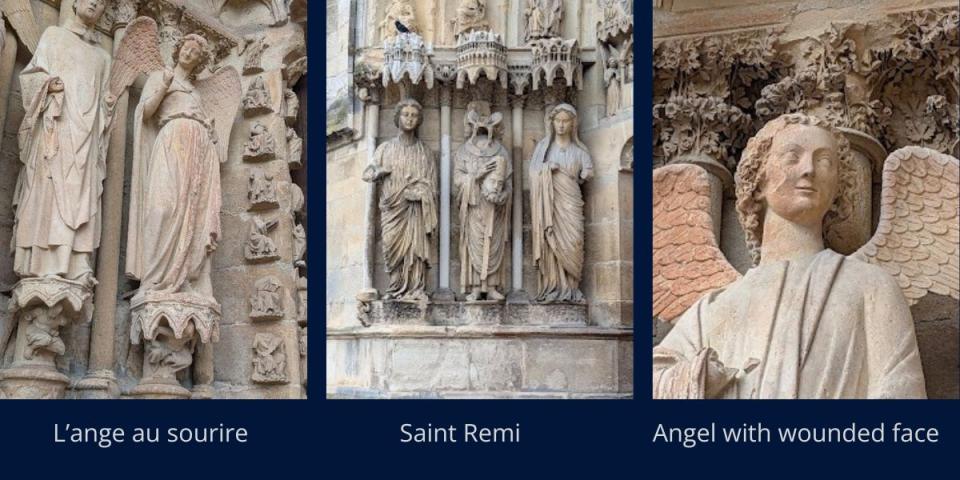
Last spring, two days after we heard the great knocks on the doors of Notre Dame that begin the Palm Sunday procession in Paris, my husband David and I took the train through green-and-gold countryside to another Notre Dame, Notre Dame in Reims—and there we saw him: l'ange au sourire, the smiling angel. He stands by the door and greets you as you enter. His is a smile of great sweetness, striking against the immensity of the place.
The cathedral is enormous. It rises in weathered stone some 285 feet at its highest point; it is a vertiginous experience to look up at the towers against the scudding clouds. The towers seem to be falling, fast, right on top of you. The roof alone, reconstructed in concrete and metal after it burnt during the German bombardment in the first months of World War 1, weighs (our guide said) some 1200 tonnes—200 tonnes more than the roof of Paris’ Notre Dame, our guide also told us, with evident satisfaction.
Rodin loved this church; he found it beautiful. I found it massive, imposing, awe-inspiring...but not beautiful.
Then I saw the angel. He has stood there, under the cross of Christ, miraculously escaping fire and revolution and two world wars. The angel looks right down on you, and his face is alight.
The angel stands under the crucifixion at the top of the tympanum (which did not escape the wars; what you see now on much of the great west façade is replica or reimagination of the church's 13th-century statuary). As Jesus is crucified, over his head, the angel smiles. How is that possible? How is it that in the face of the cross, in the face of guillotine, bullets, two world wars that destroyed 85 percent of the town and scarred the cathedral—how is it that in the face of all the bloodshed, God’s angel stands smiling upon me as I enter this church?
It is a question the cathedral poses to me, that all the churches we saw last spring pose to me, but especially this one, which greets me with bullet marks in its walls and a divine smile—and with its founding saint, Saint Remi (who baptized Clovis, King of the Franks, at Reims ca. 501, thus making France Christian) carrying his own chopped-off head.
These cathedrals, like their saints, have stood through centuries of depredation and human conflict, many of them burnt down and rebuilt on the same holy ground many times.
Later that week, David and I stopped for a service in the little Église de la Chapelle Saint Mesmin, perched on the banks of the Loire near Orléans.
Saint Mesmin was in fact Saint Maximus, who in the 6th-century built a church in this place. The villagers were terrorized by a dragon that lived in the local cave; the villagers knew there was a dragon there because of the cave’s terrible smell. So one night, Maximus, or Mesmin, rowed over to the cave with a candle and his faith and drove out the dragon by prayer. Then he built a church. That church was raided by Vikings in the 9th-century, burnt in the wars of religion, raided and burnt again, and it was rebuilt every time. There’s a little of the old Norman stone still visible, and a trail of faith that goes back 1500 years.
Such hope! Such persistence of faith. And it is not just the faith of bishops and saints and kings. It is the faith of thousands of ordinary people whose hands built these cathedrals. Our guide, on our Reims Cathedral tower walk, pointed out the comic, tragic, and scary faces high up on the outside walls.
These are the creations of local artisans. The master architect would let each artisan carve whatever face he liked here—where it could not much be seen, it is true, but the artisans did not let that stop them. The faces are wonderful, full of character, each one stamping a little of the artisan’s spirit on the great cathedral. These faces endure, and where they do not, where guns and shells have shattered them—you can see shrapnel gouges in the walls up there—others have laboured to recreate the same faces in the same stone because the work of these artisans mattered. The lives and faith of these long-gone ordinary people were precious and shall stand; that is what the old carved faces on these cathedrals say to us. They are a word of hope.
These old cathedrals root us in hope.
And that is something of what Jesus says to us too, on the cross.
The smiling angel at the door of Reims cathedral stands under the cross. You see both things together, the death and grief and human sin, and the smile in the face of God. “Peace be with you,” the risen Jesus says to his disciples that first Easter, the nail marks fresh in his hands. Peace be with you, the smiling angel says to us today, in another time of depredation, as we enter under the cross.
Nearby, another angel stands. This angel smiles more soberly, but still he smiles, and tilts his head toward the smiling angel. On his face, there is a wound from the wars. They have left it there, the wound in this angel’s face, because (the cathedral literature says) it tells the Church’s story. There is the wound in the angelic face, the nail marks in the hands of the Son of God. And there is the angelic smile. Both stand. Both are true.
We came back, later, after lunch under the cherry blossoms in the church’s garden, and a peek at the Art Deco library next door.
I looked at the angel again, and this time I saw not just his sweetness, but his glee. He looks like he’s inviting you to shout, or dance, or kick up your heels, or laugh out loud.
Glee written in stone! How is it possible, in those times, in this time? The glee of God in a stone angel’s face, speaking hope under the cross. Beautiful Reims! Beautiful faith.


