 By Jeffrey Hocking
When I consider this year’s “Vestigia Dei” blog theme of being “rooted and grounded,” I immediately think of the role of our bodies, as they are God’s gift to us, making our home in this world possible. Thinking of the body always brings me to the resurrection, which is a reaffirmation of that gift. Understanding this gift, however, has been a continuous journey for me, one that was fundamentally changed by a small book that I accidentally stumbled upon in the Calvin College library while researching something completely different. Stumbling upon this book was also a gift, one that has helped me grow in my faith.
Growing up in a religious farming community, the body was seen as something holding people back. The goal was to be free of it, and all of its limitations. That is what I originally thought the promise of the resurrection was—setting the body aside, and ascending into a spirit realm free of all bodily encumbrances and idiosyncrasies. One of my favourite hymns to sing, I’ll Fly Away, reinforced this idea for me: “When the shadows of this life have gone, I’ll fly away, like a bird from these prison walls, I’ll fly away.”
For me, the prison walls were the body. The body was something to be escaped, a temporary shell to pass through the test that is life. Passing that test meant getting to what was meaningful in the hymn, my “home on God’s celestial shore.”
Admittedly, this perspective did not lead to a particularly full view of this life. God’s creation (this world) became nothing more than a testing floor in my mind, separating the believers and unbelievers, all while serving to punish humanity for original sin. This degradation of the body and over-spiritualization led me to question the resurrection’s purpose altogether. Perhaps it was just a metaphor for consciousness? Surely God did not intend for bodies themselves to be raised—they are like the discarded cicada shell, utterly useless for our promised new form of existence.
My worldview was first put into crisis when I read Leonardo Boff’s When Theology Listens to the Poor. His last chapter in the book answers the question “How Ought we to Preach the Resurrection in a World Under Threat of Collective Death?” Here Boff says something that made me realize why the resurrection of the body may not have been a significant part of my faith—I was not in any imminent danger of having my body taken from me.
Boff writes: “In Jesus’ resurrection God has shown that he sides with the crucified of history. The executioner shall not triumph over his victim, and thereby our thirst for a world of ultimate justice, a world of communion of sisters and brothers at the last, is not cheated.”
The resurrection of the body is for the millions who, like Jesus, have had their lives snuffed out early, and their bodies discarded in unmarked graves and ditches. Part of the promise of the resurrection is reclaiming the dignity of a multitude of bodies that were discarded by obscene injustices. I can find my own way into my participation in that gift, but the radicality of the Gospel is that the body of the executed rises to life again, not in some metaphorical way, but in a corporeal way, honouring what God has created. Our bodies are not some accident, nor part of some cosmic experiment. God created bodies because that was God’s desire.
This understanding was further deepened for me in the small book I mentioned at the beginning of this blog. The book was written by the Brazilian theologian Rubem Alves, and the title is a simple statement of faith: I Believe in the Resurrection of the Body. Having read more academic theology for the past four years, I was struck by the clarity of the title, and though I had found the book by accident, I immediately read it cover to cover. I was gripped by the simple beauty of the idea presented in its pages:
“ ‘What do you want to be when you grow up?’ – that’s what we say to children. If, without irreverence, we could ask God the same thing, he would say “But you still don’t know? Haven’t I told you? I told you, and you didn’t listen. You thought I was joking. Yes, I want to be Jesus of Nazareth. I am Jesus of Nazareth. I am an ordinary man. I am all ordinary people. Especially the suffering, the weak, the abandoned.’ ‘Whenever you did it to one of these my little ones, you did it to me.’ There is nothing better than to be a man, a woman, a child. No, I don’t want fleshless human beings. Let the bodies be resurrected.”
Alves’ words shook me deep down. I had been fighting against God’s desire all my life, trying to escape the very thing God created for me to enjoy. God was so committed to the goodness of the body that He not only created it, He chose to become corporeal Himself, to enjoy communion with other bodies, not simply because sin forced His hand, but because that was His true desire – to be with us in all of our joy and suffering.
Alves continues, imagining how God responds: “No, I don’t want an end of the world, of the animals, trees, oceans, breeze. All of this is very good. Let everything be redeemed. The earth will yet be a place of laughter and play. That’s what I want, this is my desire.”
This desire is expressed throughout the biblical narrative, but it was hidden to me by my own theological assumptions. Alves aptly describes my assumptions in his prologue:
“We thought to find God where the body ends: and we made it suffer and transformed it into beast of burden, fulfiller of commands, machine for labour, enemy to be silenced, and we persecuted it in this way to the point of eulogizing death as the pathway to God, as if God preferred the smell of the tomb to the delights of Paradise.”
Despite all the evidence in Scripture, which I have read my whole life, it still feels radical for me to fully comprehend what it means that God loves the world. I cannot imagine what it means to be ‘rooted’ without understanding this aspect of God’s love. I was an alien to myself, always looking to escape what I thought was never meant to last. In this worldview, I was rootless, never able to connect with myself, nor really with God, as I could not understand God’s desires or intentions.
With this fuller picture—that God desires the body so much that He demands its resurrection—I am better able to be at home in God’s world. Yes, it is a world marred by sin. But our world as broken as it is, is a shadow of God’s intention, one that He desires so much that He will give it to resurrected bodies to laugh and play in as intended. God desired this so much that He became Jesus of Nazareth, not just for a time, but eternally as the first resurrected body in God’s promised kingdom. It is this kingdom from which my roots are meant to be fed, and which they will one day be planted in, bodily, but without the pain of sickness, death, or oppression.
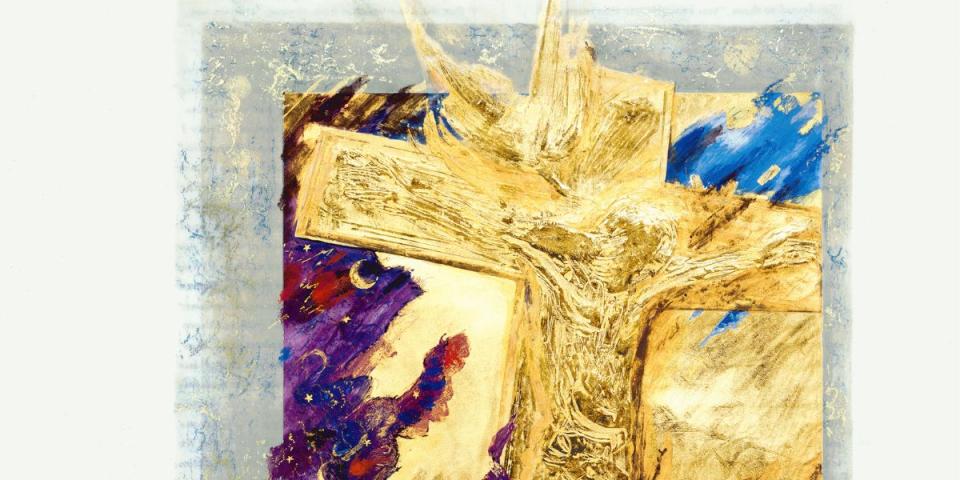
Image: Crucifixion, detail
Donald Jackson, © 2002 The Saint John’s Bible, Saint John’s University, Collegeville,
Minnesota, USA. Used with permission. All rights reserved.


